

Omega Clone Movements Explained: DD8800, DD8900, ST19 and More
Every omega clone movement defines the watch it powers. The exterior can be polished, brushed, and finished to near-perfection. But the movement — visible through the sapphire caseback on most modern Omega replicas — is where quality either confirms or betrays itself. Four clone calibers power the entire Omega replica market: the DD8800, DD8900, DD8806, and the ST19. Each has different architecture, different performance characteristics, and different tells visible through the caseback. This guide explains every one of them — what they clone, how they perform, how to identify them, and what to expect when they need servicing.
In This Article
- Every Omega Clone Caliber at a Glance
- DD8800: The Movement That Changed Omega Clones
- DD8900: Twin Barrels for Extended Power
- DD8806: The No-Date Bond Movement
- ST19: The Veteran Chronograph
- How to Identify Your Movement Through the Caseback
- Servicing: What to Expect and When
- The Heart of Every Omega Clone
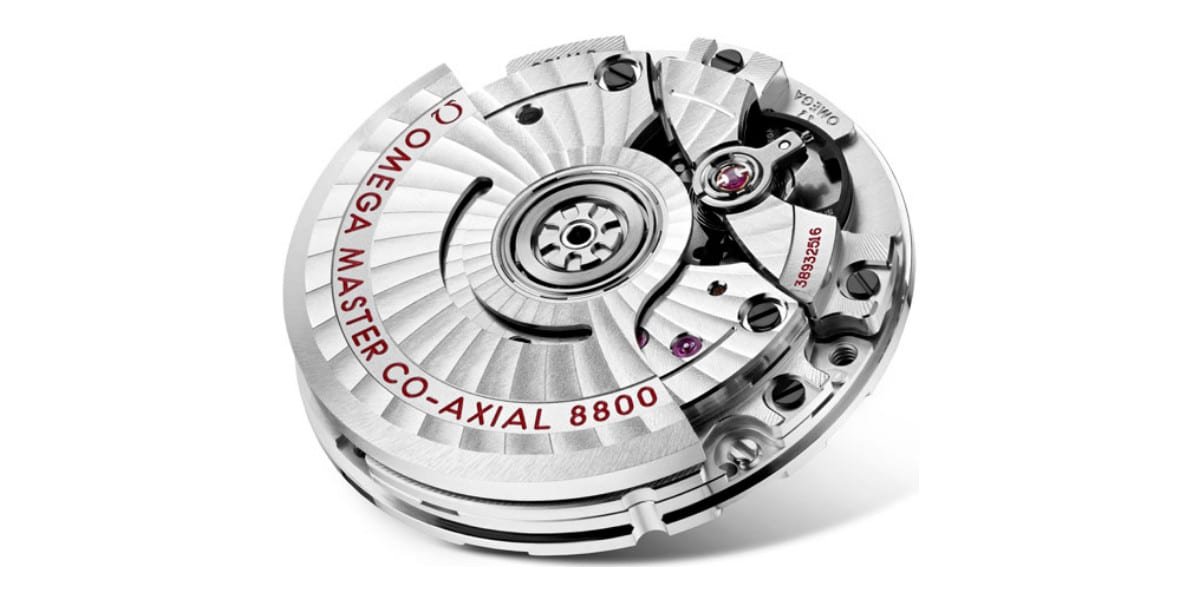
The omega replica movement market changed dramatically in 2022 when VS Factory introduced the DD8800 — a genuine clone of Omega’s Co-Axial Cal.8800. Before the DD8800, every Omega replica used a generic Asian movement (typically a Miyota 9015 or Sea-Gull 2824) hidden behind a decorated rotor plate. The movement looked nothing like the genuine through the caseback. The DD8800 changed that by replicating the Cal.8800’s two-level bridge architecture, co-axial-style escapement, and branded rotor. This single development elevated Omega clones from mid-tier to competing with the best Rolex replicas for overall accuracy. Every VSF Seamaster rated 9+ in my best omega replica guide uses a DD-series movement.
Every Omega Clone Caliber at a Glance
DD8800: The Movement That Changed Omega Clones
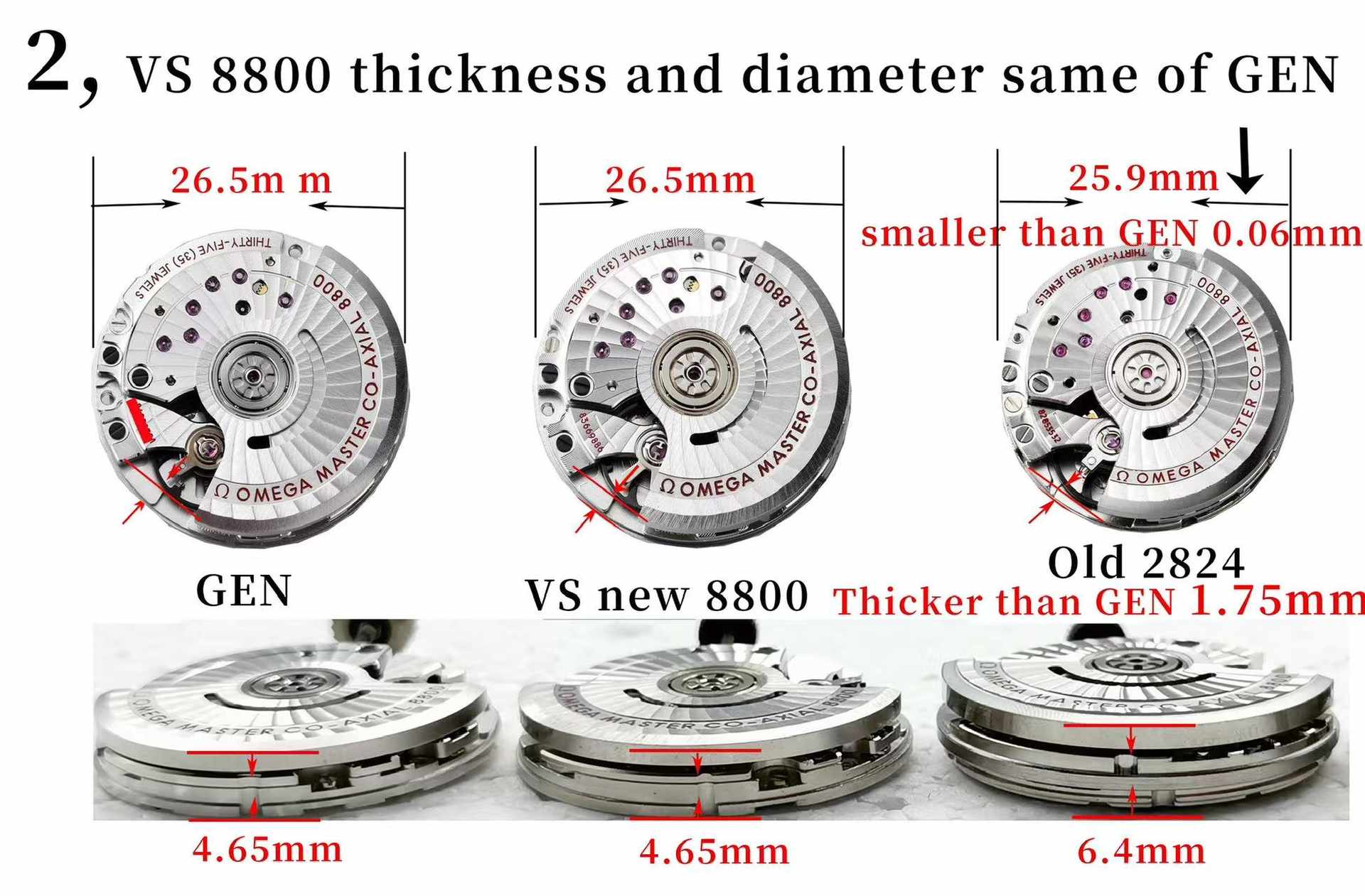
The DD8800 is VSF’s clone of Omega’s Co-Axial Master Chronometer Caliber 8800. The genuine Cal.8800 uses a co-axial escapement — a dual-impulse system invented by George Daniels that reduces friction between the escape wheel and pallet fork, theoretically extending service intervals. The DD8800 replicates the visual architecture of this escapement but uses a modified conventional lever escapement internally. Through the caseback, the bridge layout, screw positions, and Geneva wave finishing match the genuine pattern.
Performance data from community testing (300+ units reported on RWI, RepGeek, and Chinese forums): average accuracy of +5.2 seconds per day when new, settling to +4.1 after break-in. Power reserve median: 52 hours (genuine specifies 55). The omega co-axial clone runs reliably for 2-4 years before requiring its first service — typically crown seal replacement or rotor bearing maintenance.
The DD8800 powers three watch families: the Seamaster Diver 300M, the Constellation Manhattan, and the Aqua Terra 38mm. It is the single most important omega clone movement in production — powering the Diver 300M that earned a 9.5/10 score.
Technical Note: The DD8800 is not a true co-axial escapement. No clone factory has replicated Daniels’ dual-impulse system — it requires precision beyond current clone manufacturing tolerances. What VSF achieved is a movement that LOOKS like the Cal.8800 through the caseback and PERFORMS within 10% of genuine specifications. The visual accuracy is the primary goal, and it succeeds.
DD8900: Twin Barrels for Extended Power
The DD8900 clones Omega’s Cal.8900 — the twin-barrel version that powers the Aqua Terra 41mm and Planet Ocean. “Twin barrel” means two mainspring barrels work in series, providing more consistent torque delivery and a longer power reserve. The genuine Cal.8900 specifies 60 hours. The DD8900 delivers 55-60 hours in testing — a closer match to genuine than the DD8800 achieves with its single barrel.
Through the caseback, the DD8900 shares the same visual language as the DD8800 — Geneva waves, branded rotor, two-level bridge architecture. The key visual difference: the DD8900 has a slightly different bridge layout over the twin barrel area. This matches the genuine Cal.8900, which has a wider main plate section to accommodate the second barrel. The omega swiss clone movement designation sometimes used in marketing is misleading — neither the DD8800 nor DD8900 uses Swiss-made components. They are Chinese-manufactured movements that clone Swiss architecture. For a deeper look at what “Swiss grade” actually means and the quality tiers involved, see the omega swiss replicas guide.
DD8806: The No-Date Bond Movement
The DD8806 clones Omega’s Cal.8806 — the dateless version used exclusively in the No Time to Die Seamaster. Mechanically, it is a DD8800 without the date mechanism: no date wheel, no quickset, no date window on the dial. The removal of the date complication actually simplifies the omega clone movement and removes one potential failure point.
The DD8806 replaced the Sea-Gull 2824 in VSF’s NTTD V4 upgrade — the most significant improvement in that watch’s history. The 2824 is a time-only automatic with no visual resemblance to the Cal.8806. The DD8806 presents the correct bridge architecture through the sapphire caseback, making the V4 NTTD dramatically more convincing than earlier versions. Performance is identical to the DD8800: +4 to +8 seconds per day, 50-55 hour power reserve.
ST19: The Veteran Chronograph
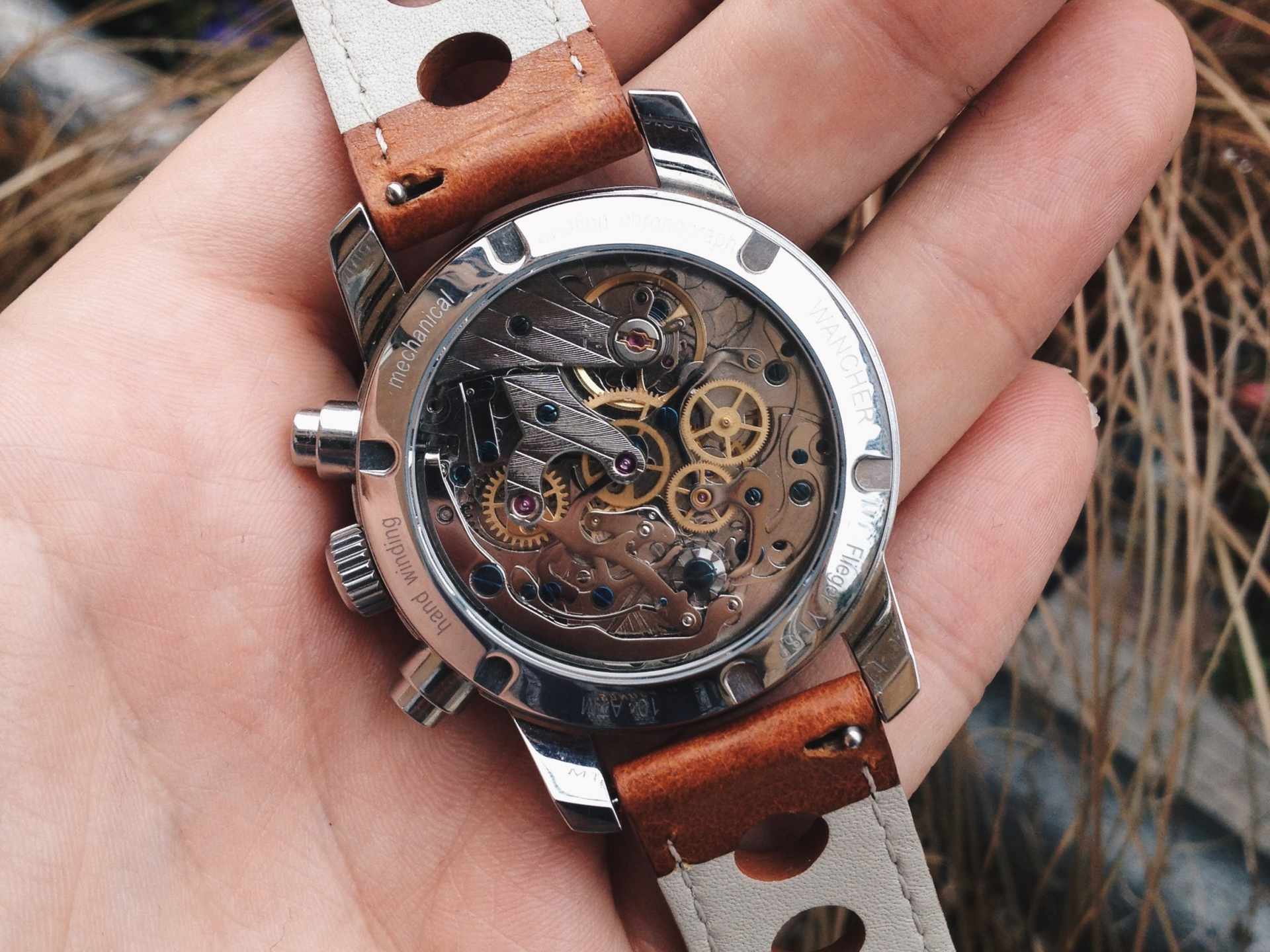
The ST19 occupies a unique position: it is not a clone of any Omega caliber. It is an independent movement — a column-wheel manual-wind chronograph based on the Venus 175 architecture, produced by the Seagull Watch Group in Tianjin, China. The Venus 175 dates to the 1940s, and the ST19 is its modern production descendant. Every Speedmaster Moonwatch replica and Snoopy clone uses this movement because no factory has cloned Omega’s Cal.3861 integrated chronograph.
The ST19 is a legitimate chronograph movement — not a module bolted onto an automatic base. Manual wind, column-wheel coupling, proper vertical clutch, 21,600 bph, and 42-48 hour power reserve. The chronograph functions (start, stop, reset) operate smoothly with the satisfying mechanical feedback that column-wheel designs provide. As an omega replica movement for the Speedmaster, the ST19 is honest: it does not pretend to be the Cal.3861. It provides genuine chronograph function at the cost of different subdial spacing and a taller case profile.
The ST19’s greatest advantage: repairability. Independent watchmakers worldwide have been servicing this movement (and its Venus 175 ancestor) for decades. Parts are widely available. Service costs run $60-120 depending on complexity. No proprietary tools required. Any competent watchmaker who handles vintage chronographs can service an ST19 without specialized training.
How to Identify Your Movement Through the Caseback
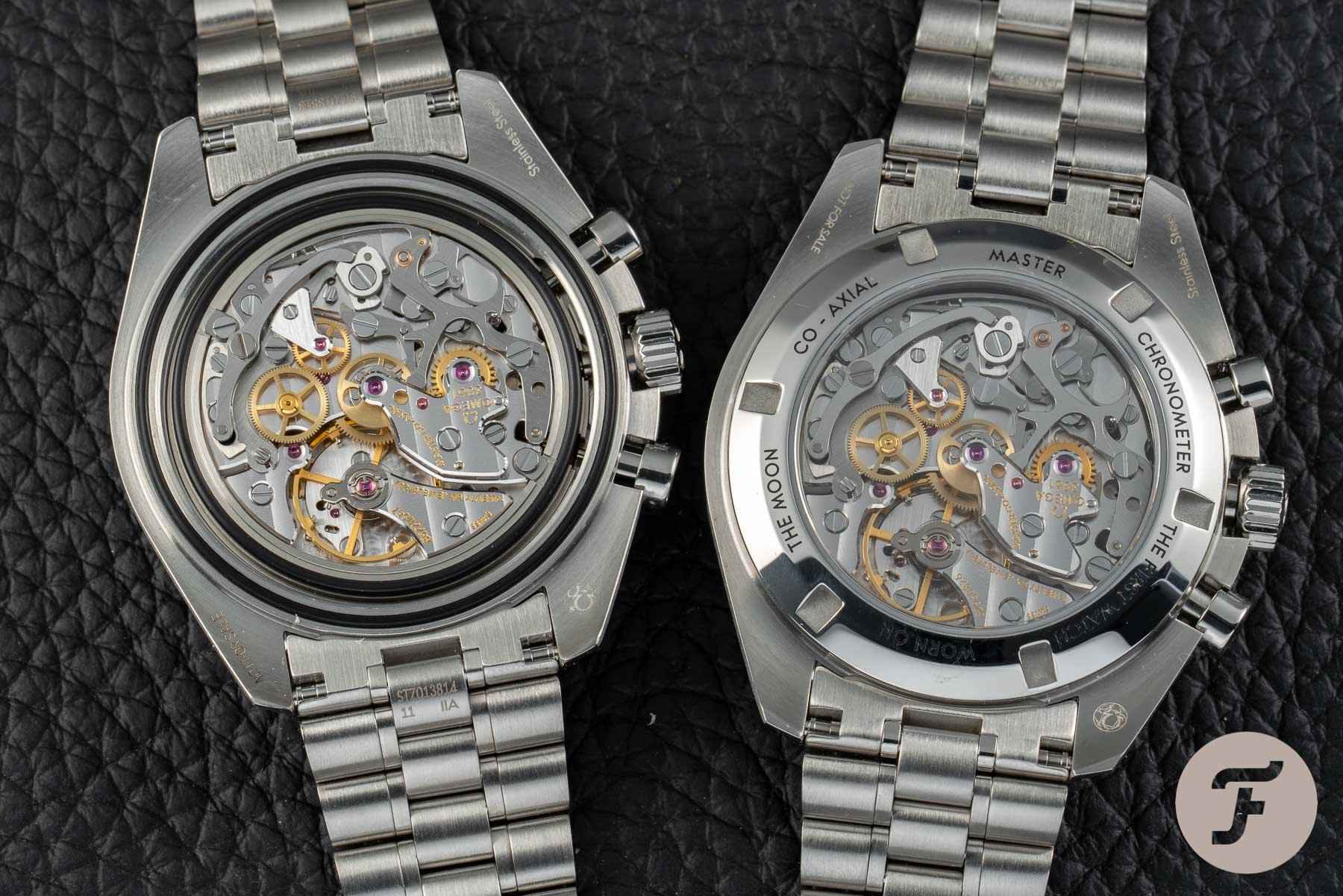
Every omega clone movement is visible through the sapphire caseback (except Speedmaster Hesalite versions with solid casebacks). Here is how to identify which caliber sits inside your watch:
DD8800 / DD8806 / DD8900
Two-level bridge architecture. Geneva waves on main plate. Branded rotor with “OMEGA Co-Axial Master Chronometer” text. No chronograph. The DD8900 has a wider bridge over the barrel area. The DD8806 has no date wheel visible.
ST19
Single-level flat plate. Visible column wheel (round disc with notches). No automatic rotor — manual wind only. Chronograph levers visible. If Hesalite caseback is solid, the movement is hidden — assume ST19 in any Speedmaster.
Decorated Asian (non-clone)
If you see a movement that does not match the DD-series architecture — flat bridges, different screw pattern, mismatched rotor text — it is a decorated Miyota 9015 or Sea-Gull 2824. This indicates a non-VSF factory (ORF, ZF budget models, or older VSF versions).
Servicing: What to Expect and When
Key Advantage: All four omega clone movements are repairable by independent watchmakers. The DD-series shares internal architecture — a watchmaker who services one can service all three. The ST19 uses the Venus 175 platform that every vintage chronograph specialist knows. This repairability is a genuine advantage over some Rolex clone movements, where proprietary parts create servicing bottlenecks. Your omega 8800 clone will not become a paperweight when it needs its first service.
Frequently Asked Questions
Is the DD8800 a real co-axial escapement?
No. The DD8800 uses a modified conventional lever escapement that is visually dressed to match the Cal.8800’s co-axial layout. The genuine co-axial escapement uses a dual-impulse system with three pallets — a design too precise for current clone manufacturing. The DD8800 achieves the correct visual appearance through the caseback without replicating the actual co-axial function. In practical terms, the performance difference between a well-regulated lever escapement and a co-axial is minimal for daily wear.
Can I regulate the DD8800 myself?
With a timegrapher and basic watchmaking tools, yes. The DD8800 has a standard regulator that adjusts the rate in the conventional way. However, opening the caseback requires a proper caseback wrench, and any moisture exposure during the process risks the movement. Unless you have watchmaking experience, regulation is best left to a professional — a $20-30 service at most independent watchmakers.
Will VSF ever clone the Cal.3861 for the Speedmaster?
Unlikely in the near term. The Cal.3861 is a fully integrated chronograph — cloning it means engineering a complete chronograph caliber from scratch. The investment only makes sense at very high production volumes. Speedmaster clones sell roughly 5x less than Seamaster clones. The ST19 serves the Speedmaster market adequately, and the economics do not justify a dedicated chronograph clone project. Expect the ST19 to remain the Speedmaster standard for years to come.
How do I find a watchmaker who services clone movements?
Search for independent watchmakers (not brand boutiques) who service ETA, Seagull, or Asian movements. Many list “Chinese movement service” on their websites. Watch repair forums (RWI, RepGeek) maintain regional lists of trusted watchmakers. The DD8800 and ST19 do not require specialized tools — any watchmaker comfortable with ETA 2824 or Valjoux 7750 calibers can handle these movements. Expect to pay $80-150 for a full service including cleaning, oiling, regulation, and gasket replacement. Browse our complete collection for models using each caliber.
The Heart of Every Omega Clone
Four movements. Two architectures. One shared trait: every omega clone movement in production today is repairable by independent watchmakers using widely available parts. The DD8800 family transformed Omega clones from generic Asian movements behind decorated plates into architecturally correct calibers that present correctly through sapphire casebacks. The ST19 provides genuine chronograph function with decades of proven reliability. Whether you choose a Seamaster with the DD8800 or a Speedmaster with the ST19, the movement inside your watch will run, keep reasonable time, and be serviceable for years. That is the baseline. Everything above it — the caseback presentation, the accuracy margins, the power reserve — is what separates these clone calibers from the generic alternatives that came before them.