
How to Spot a Fake Omega Watch: 9 Tests That Never Lie
How to spot fake Omega watches — a question many buyers ask. At the low end of the market the answer is quick, because cheap fakes make the same stupid mistakes over and over. The thing is, modern super clones are a different animal entirely, and a few of these tests won’t catch them. I’ll be honest about that too. Here are nine checks, ranked from easiest to hardest.
Why This Matters in 2026
The fake omega watch market has split into two completely separate worlds. On one side, you’ve got $30 street fakes that wouldn’t fool a child. Wrong fonts, light as a toy, quartz ticking. On the other side, $400+ super clones with clone co-axial movements, correct ceramic bezels, and proper lume. Most YouTube “authentication guides” only teach you to spot the cheap stuff. I want you to understand both levels — and where even the best clones still fall short of the genuine article.
A quick word before we start. A scratched-up gen from 2008 with a replaced dial can actually look more suspicious than a fresh super clone. Context matters. These nine tests work best when you use them together — no single test is foolproof.
In This Article
- Why This Matters in 2026
- Test 1: The TACHYMÈTRE Accent — Instant Giveaway
- Test 2: Serial Number Verification
- Test 3: The Weight Test — Numbers Don’t Lie
- Test 4: Dial Printing Under a Loupe
- Test 5: Caseback Engraving Depth
- Test 6: The Magnetic Test
- Test 7: Seconds Hand Sweep
- Test 8: Date Window and Cyclops
- Test 9: Bracelet and Clasp Quality
- Putting It All Together: The Scoring Card
- Bonus: Three Mistakes People Make When Authenticating
- Model-Specific Quick Checks
- The Movement — The Ultimate Test
- Where to Get Professional Authentication
- FAQ: How to Spot Fake Omega
Test 1: The TACHYMÈTRE Accent — Instant Giveaway
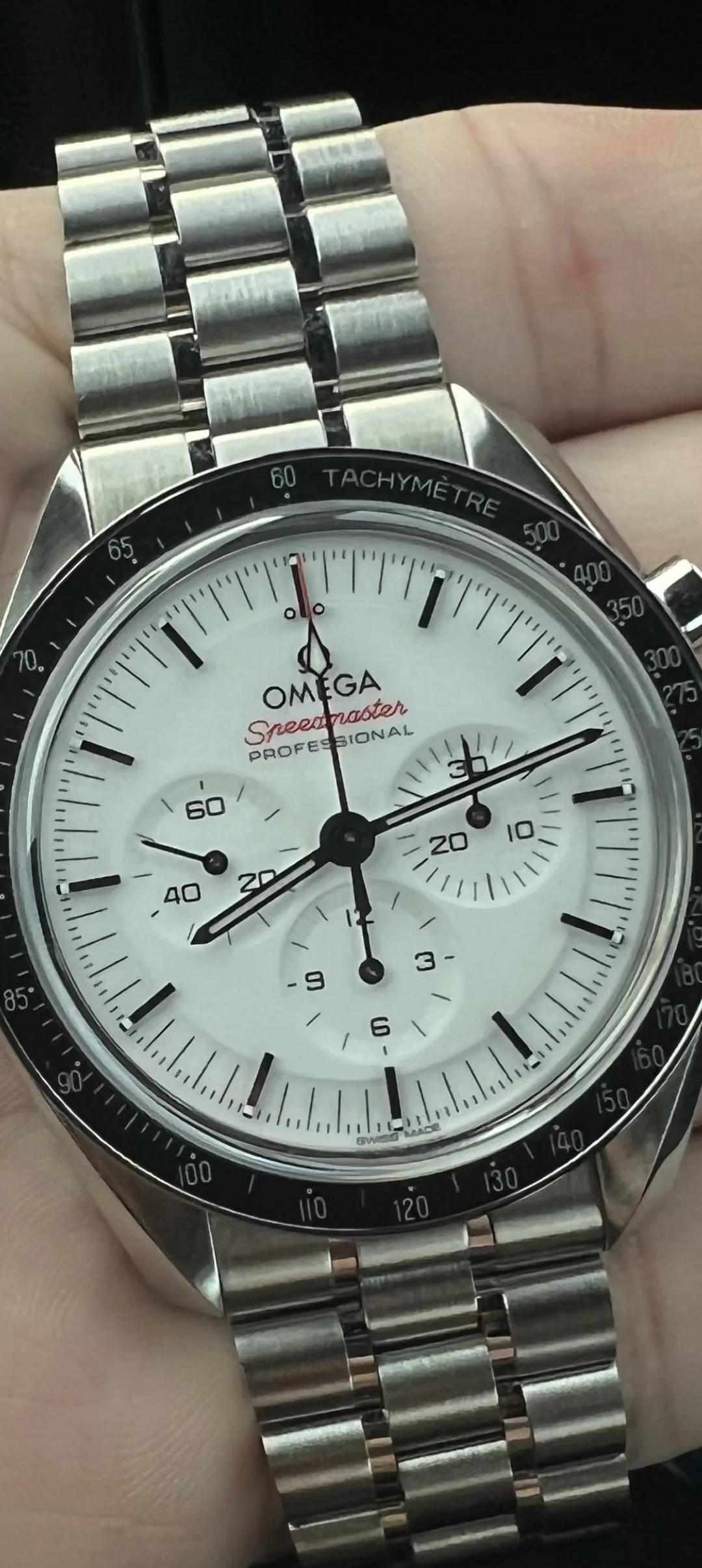
Start with the Speedmaster bezel. On every genuine Omega Speedmaster, the tachymeter scale reads TACHYMÈTRE — with a grave accent over the E. Most cheap fakes print TACHYMETRE or TACHYMETER. No accent. Some even spell it TACHIMETRE. Look at that single letter with a loupe, and you’ve already filtered out 70% of street fakes.
Why do factories get this wrong? Because the font files they use often strip diacritical marks. The accent requires a custom character in the printing template. Lazy fakes skip it. Better clones include it, but the angle and depth of the engraving sometimes differs — the genuine accent sits at exactly 72 degrees, printed into the ceramic with a laser.
Quick Check: No accent on TACHYMETRE? Walk away immediately. It’s a sub-$50 fake. If the accent IS there, keep testing — it only means the maker wasn’t completely careless.
Test 2: Serial Number Verification
Every genuine Omega produced after 1998 has an eight-digit serial number engraved on the caseback or between the lugs (depending on era). Since the Master Chronometer series, the number appears on the caseback alongside a pictogram cluster — the Seahorse, Ω symbol, and Geneva observatory logo.
Here’s how to spot fake Omega serials. Grab the number and check it against Omega’s known serial ranges. The format changed over the decades:
Cheap fakes often use “placeholder” serials like 12345678 or repeat digits. Some use serial numbers that belong to completely different models. A Speedmaster serial on a Seamaster case? Dead giveaway. Top-tier clones use randomized valid-range serials — those require Omega’s own database to catch, which only authorized dealers can access.
Test 3: The Weight Test — Numbers Don’t Lie
This is my favorite test because it requires zero expertise. Just a kitchen scale accurate to 1 gram. A genuine Omega Seamaster 300M on bracelet weighs approximately 175-185 grams. A genuine Speedmaster Professional on bracelet hits around 155 grams. Constellation on bracelet, about 140-150g.
Cheap fakes weigh 20-40% less. They use hollow endlinks, thinner casework, and lighter movements. A quartz-powered fake Seamaster might weigh 120g — immediately obvious on a scale. Better clones close the gap to within 5-10 grams because they use genuine 316L steel and solid endlinks.
Pro Tip: Weigh on a rubber strap too. Bracelet link count varies, throwing numbers off. The head (case + crystal + movement) alone should match within 3-4 grams on a genuine piece.
Test 4: Dial Printing Under a Loupe
Borrow a 10x jeweler’s loupe. Cost: about eight dollars. Value: priceless. Under magnification, genuine Omega dials show crisp, clean printing with zero bleeding. The “OMEGA” logo should have perfectly sharp edges. The Ω symbol’s feet should be symmetrical. The word “SEAMASTER” or “SPEEDMASTER” below should sit on a perfectly straight baseline.
Cheap fakes reveal blurred edges, ink bleeding into the dial texture, and inconsistent spacing. The “Swiss Made” text at 6 o’clock is often too thick or too thin. On the Seamaster wave dial specifically, look at where the printed text crosses the wave pattern — on genuine pieces, the text sits crisply ON TOP of the waves. Bad fakes print text that sinks INTO the waves.
Even with a loupe, top-tier clones pass this test. The DD8800-equipped clones from quality factories use pad printing that’s nearly indistinguishable from gen at 10x. You’d need a 40x+ microscope to see differences in dot structure. For casual authentication though, a 10x loupe catches 80% of fakes on dial printing alone.
Test 5: Caseback Engraving Depth
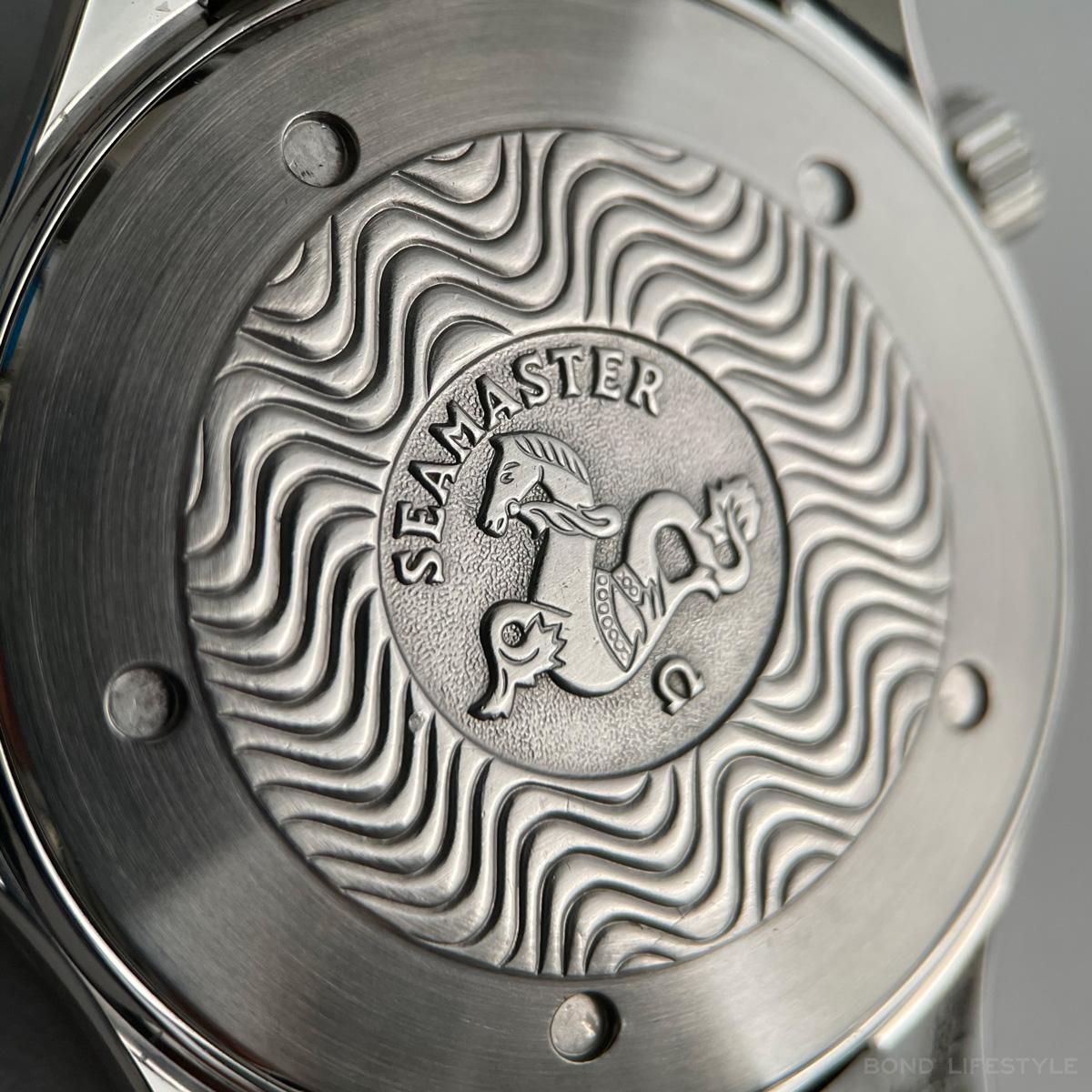
This is where how to spot fake Omega gets tactile. Run your fingernail across the caseback engraving. On a genuine modern Omega, the Seahorse hippocampus logo is laser-etched with distinct depth — you can feel the grooves. The Geneva observatory symbol (on Master Chronometer models) has a fine, precise texture.
Cheap fakes use shallow chemical etching or screen printing. The hippocampus looks flat and lifeless. Lines that should be sharp appear soft. The worst offenders print the caseback graphics as a sticker. On transparent casebacks (Speedmaster Moonshine Gold, some AT models), check that the sapphire crystal sits flush and the rotor decoration matches official photos.
For the Seamaster 300M specifically, the caseback has a deep-relief Seahorse with a 3D effect — the waves around it have actual texture. Fakes below $100 make this completely flat. The clone movements inside quality replicas often have properly decorated rotors, but the caseback engraving depth still tends to be about 60% of genuine.
Test 6: The Magnetic Test
Omega has been producing Master Chronometer certified watches since 2015, rated to resist magnetic fields of 15,000 gauss. This means a genuine modern Omega should be completely unaffected by household magnets. Grab a fridge magnet. Hold it near the watch. On a genuine Master Chronometer — zero effect. The silicon hairspring and non-ferrous components ignore it completely.
Most fake omega watches use standard steel components and conventional hairsprings. A fridge magnet held near the dial will slightly magnetize the movement, causing the watch to gain 30-60 seconds per day afterward. You won’t see an immediate effect, but check the timekeeping over the next few hours. If it suddenly gains time after magnet exposure, the anti-magnetic claim is fake.
Caveat: Pre-2015 genuine Omegas are NOT anti-magnetic. A vintage Seamaster from 2010 will react to magnets just like a fake. This test only works for watches claimed to be Master Chronometer certified.
One tricky detail: some high-end clones use silicon hairsprings in their clone movements. The top-tier factories invested in anti-magnetic balance springs specifically to pass this test. It’s an arms race.
Test 7: Seconds Hand Sweep
Omega fake vs real — the seconds hand reveals a lot. Every genuine modern Omega runs a mechanical movement at 25,200 vibrations per hour (3.5Hz) or 28,800 vph (4Hz). That means the seconds hand moves in 8 or 10 tiny steps per second, appearing as a smooth sweep to the naked eye.
A quartz fake ticks once per second. One full jump. Dead obvious. But here’s where testing gets harder: many mid-range fakes use Miyota 8215 movements (21,600 vph / 3Hz), which also sweep — just slightly less smoothly. The difference between 3Hz and 3.5Hz is subtle without a timegrapher.
What to look for: hold the watch near your ear. A genuine Omega co-axial movement has a distinct, softer ticking sound — the co-axial escapement produces less friction noise than a standard Swiss lever. Miyota movements are louder and slightly rougher. Clone co-axial movements (DD8800, DD8900) mimic this softer sound quite well, making audio detection unreliable against top clones.
Test 8: Date Window and Cyclops
Not all Omegas have date windows, and none have cyclops lenses (that’s Rolex). But the Seamaster 300M, Aqua Terra, Planet Ocean, Constellation, and De Ville all feature date displays. The genuine date window has specific tells:
- Font: Omega uses a proprietary sans-serif date font. Numbers are slightly bold, perfectly centered in the window
- Color: White or silver date wheel on dark dials, black on light dials. Never yellowish
- Position: The date sits at exactly 3 o’clock (Seamaster, AT) or 6 o’clock (some special editions). Alignment must be dead center
- Transition: Genuine date changes happen cleanly between 11:50 PM and 12:10 AM. Cheap fakes often have slow, dragging transitions that take 30+ minutes
Omega fake vs real becomes most obvious on the date wheel printing. Under a loupe, genuine Omega dates have perfectly consistent ink density on every number. Fakes often show thicker ink on “1” and “2” but thinner on wider numbers like “8” and “0”. The date wheel alignment also drifts — genuine Omega holds center position on all 31 dates, while fakes wobble slightly between numbers.
Test 9: Bracelet and Clasp Quality
The bracelet is where even good clones struggle. Genuine Omega bracelets have specific engineering that’s expensive to replicate correctly. What to check:
Solid endlinks (SEL): On a genuine Seamaster or Speedmaster, the endlinks are solid machined steel that fits flush against the case with zero gap. Cheap fakes have hollow endlinks with visible gaps. Even on quality clones, the endlink-to-case fitment often has a 0.3-0.5mm gap that genuine pieces don’t have.
Clasp mechanism: Genuine Omega uses a push-button deployant clasp with micro-adjust (on newer models). The buttons should click firmly — not mushy, not stiff. The Omega logo on the clasp buckle should be deep-engraved, not printed. On the Seamaster, the diver extension folds out smoothly from inside the clasp.
Link finishing: Flip the bracelet over. Genuine Omega polishes the center links and brushes the outer links (on Seamaster) with zero transition marks. The brushing should be perfectly parallel. Cheap fakes show uneven brushing patterns and rough edges where the polished and brushed surfaces meet.
Putting It All Together: The Scoring Card
This guide uses a simple pass/fail system. Each test gets a point. Here’s how to tell if Omega is real using the composite score:
Here’s the honest truth about omega authentication in 2026. For watches scoring 7-8 out of 9, you need professional tools: a timegrapher for beat rate and amplitude, a UV light for lume analysis, and ideally a jeweler who can open the caseback. The detailed differences between genuine and replica Seamasters go deeper than what’s visible to the naked eye. At the highest level, factory QC photos and serial number database checks become the only reliable methods.
Bonus: Three Mistakes People Make When Authenticating
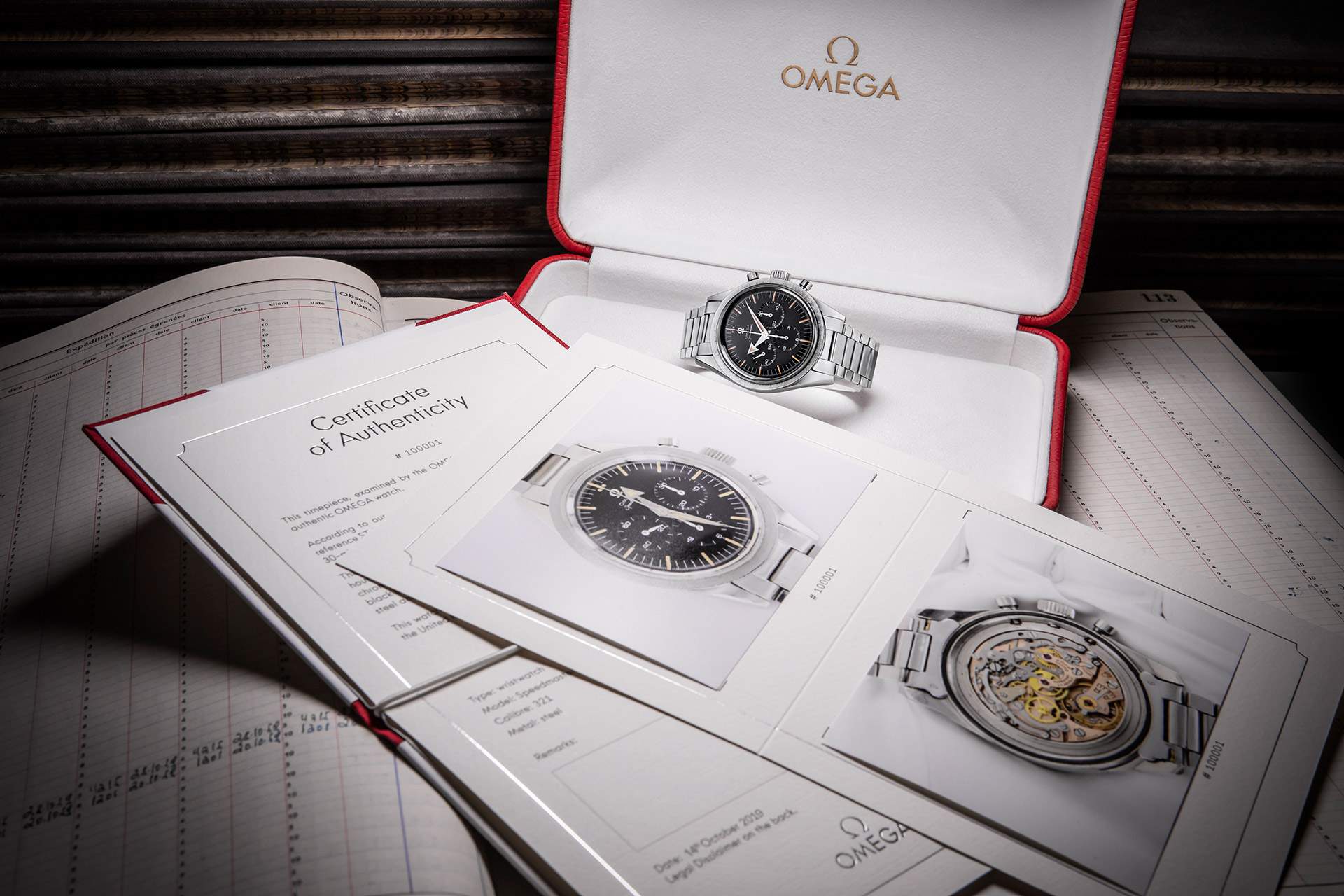
Mistake 1: Trusting the box and papers. Fake boxes, warranty cards, and even COSC certificates are widely available. The packaging industry for replica accessories is almost as developed as the watch cloning itself. A genuine-looking red Omega box proves exactly nothing. Check the watch, not the box.
Mistake 2: Relying on a single test. Some buyers declare a watch fake because “the lume color looks slightly different.” Lume color varies between genuine production batches. Super-LumiNova ages differently depending on light exposure. A single data point isn’t enough. Run all nine tests and look at the pattern.
Mistake 3: Assuming price proves authenticity. A Seamaster 300M selling for $3,500 “used” could still be a super clone. That’s below retail but not suspiciously cheap for pre-owned. Scammers price fake omega watches at realistic used-market levels specifically to avoid suspicion. The $200 “Omega” on a street corner is easy to reject — the $3,500 one on a trusted platform is harder to question.
Model-Specific Quick Checks
Different Omega models have unique tells. Here’s a cheat sheet for the four main collections on the Seamaster lineup and beyond:
The Movement — The Ultimate Test
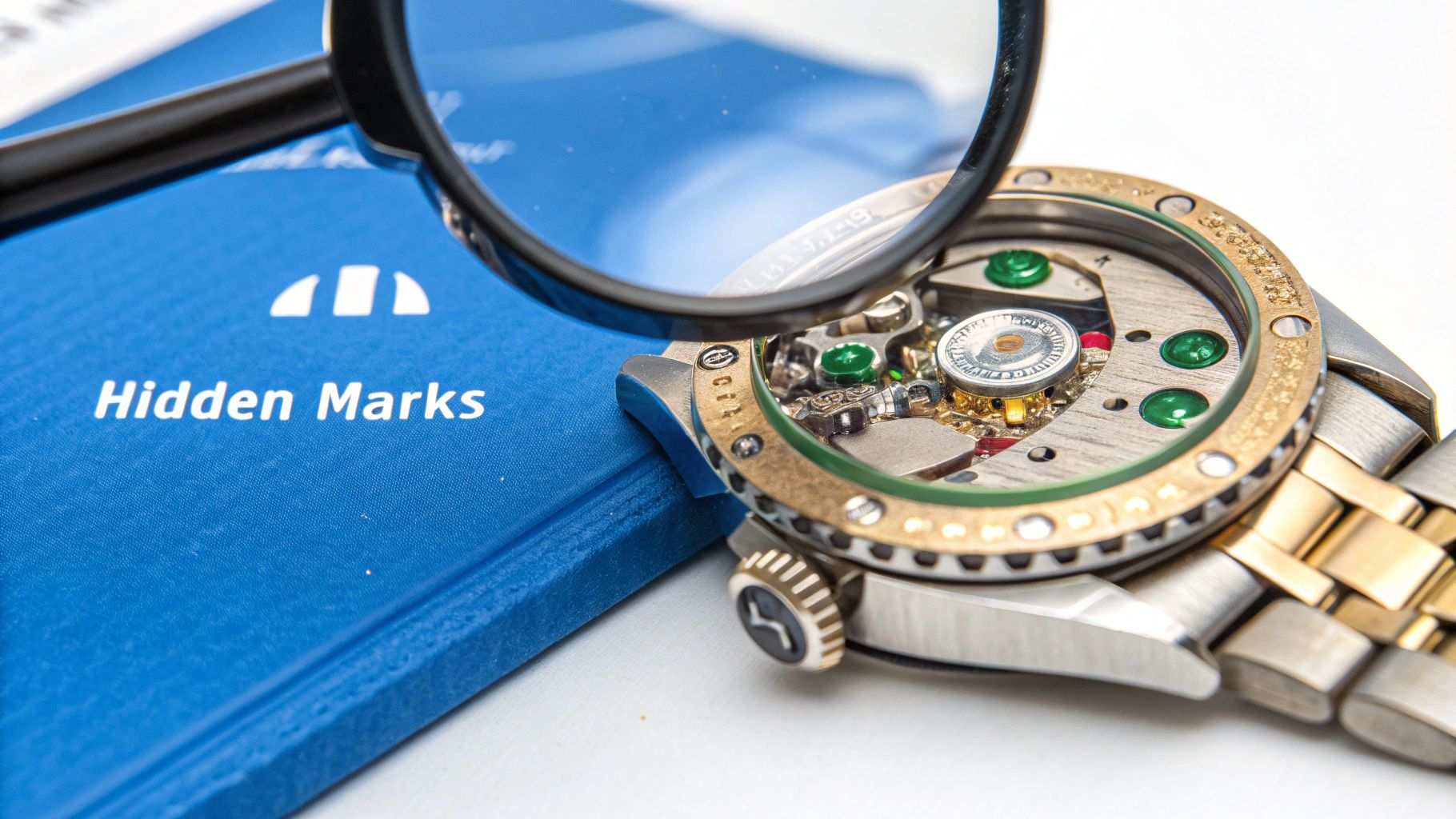
Opening the caseback is the nuclear option. It requires a caseback wrench and some skill, but it reveals everything. Inside a genuine modern Omega sits a METAS-certified movement with a distinctive arabesque Geneva wave pattern, red accents on the balance bridge (on newer calibers), and the Omega Ω engraved on the rotor.
What to look for inside a fake omega watch: unfinished edges on the bridges, a blank rotor weight (no branding), visible tool marks, and mismatched screw heads. Mid-range fakes hide a Miyota or Sea-Gull movement — completely different architecture from Omega’s in-house calibers. You’d see standard lever escapement instead of the co-axial’s distinctive pallet fork geometry.
Understanding how clone Omega movements work actually helps with authentication. Knowing what the DD8800 looks like — and how it differs from a genuine Cal.8800 — means you can distinguish a $400 clone from a $5,000 genuine even with the caseback open. The clone uses different bridge screws, a slightly different date mechanism, and the rotor weight has marginally less polishing depth.
Important: Never open a caseback yourself unless you know what you’re doing. Water resistance depends on correct gasket seating. A botched caseback opening can ruin a perfectly good watch — genuine or otherwise.
Where to Get Professional Authentication
If you’re buying used and want absolute certainty:
- Omega boutique / service center: The gold standard. They check the serial against their database and inspect the movement. Takes 1-3 days, may cost a small fee
- Independent watchmaker: An experienced watchmaker can open the caseback and identify the movement within seconds. Cheaper and faster than Omega official
- Online authentication services: Services like LegitCheck or WatchCSA offer photo-based authentication. Useful for a quick second opinion but not as reliable as hands-on inspection
- Trusted dealer verification: Authorized pre-owned dealers (Watchfinder, Crown & Caliber) authenticate before listing. Buying from them reduces risk significantly
The investment in professional omega authentication is worth it for any purchase above $1,000. A $50-100 service fee that confirms authenticity — or saves you from a $3,000 mistake — pays for itself instantly.
FAQ: How to Spot Fake Omega
What’s the easiest way to spot a fake Omega?
Weight test. Grab a kitchen scale. A genuine Seamaster 300M on bracelet weighs around 178g. Most cheap fakes come in under 130g. Takes ten seconds, requires zero expertise. If it passes the weight test, move on to the TACHYMÈTRE accent (Speedmaster) and dial printing under a loupe.
Can a jeweler tell if an Omega is fake?
An experienced watchmaker can identify most fakes by opening the caseback and examining the movement. For top-tier super clones, they’d need to compare specific bridge finishing details and screw patterns. Any Omega boutique or service center can run the serial number against their internal database — that’s the definitive check.
How to tell if Omega is real by the serial number?
Every genuine Omega has a unique 8-digit serial on the caseback. Check the format matches the era (see the table above). Generic numbers like 12345678, duplicated digits, or serials from the wrong model range are red flags. For absolute confirmation, only Omega’s internal database can verify a specific serial.
Are super clone Omegas hard to spot?
Yes. Top-tier clones score 7-8 out of 9 on the tests above. They match genuine weight, have correct dial printing, working clone co-axial movements, and proper ceramic bezels. The remaining tells are subtle: endlink fitment, caseback engraving depth, and serial database verification. Without professional tools, these clones are very difficult to identify — which is the whole point of the factory quality tiers that exist in the market.
Does Omega have an online authenticity checker?
Omega doesn’t offer a public online serial number checker. You need to visit an authorized Omega boutique or service center for official verification. Some third-party platforms like Chrono24 offer buyer-protection authentication, and services like WatchCSA do photo-based checks, but the definitive answer always requires hands-on inspection and Omega’s internal records.
Final Word
Learning how to spot fake Omega watches is a skill that improves with practice. The first time, you’ll spend thirty minutes checking everything. After a few dozen watches, you’ll develop an eye that catches the obvious stuff in seconds. The weight, the printing, the caseback depth — these become instinctive.
The real takeaway? No single test is conclusive. Use the nine-point scoring system together. And for any purchase that matters — anything you’re spending serious money on — spring for professional authentication. Your wallet will thank you. Browse the full Omega collection to familiarize yourself with how each model should look, feel, and wear. The more genuine references you study, the faster your eye develops.