
How close does a Speedmaster clone get to the real Moonwatch?
An Omega Speedmaster copy can match the real Moonwatch on the 42mm case, the black tachymeter bezel and the three-counter dial, and still give itself away to someone who knows the watch. Fake vs real, it comes down to seven details. Two come from the movement most clones use, and no amount of finishing hides them; five more you can check yourself on the photos and video of a watch before you buy. This guide sets a fake Omega Speedmaster beside Omega’s hand-wound Moonwatch Professional and goes through each one, then covers the movement, the crystal choice and the factories.
In This Article
- Omega Speedmaster Fake vs Real: The Two Tells
- How to Spot a Fake Omega Speedmaster: 5 More Checks
- The ST19 Movement: What You Get Instead of Cal.3861
- Hesalite vs Sapphire: Which Crystal to Choose
- Factory Comparison: SMF vs OMF vs JH
- Why the Moonwatch Matters: A Quick History
- Who Should Buy the Speedmaster Clone — And Who Should Not
- The Final Calculation
The Speedmaster Moonwatch Professional with the white dial is number six of the nine watches in our best Omega replica picks, which go through the Omega lines one by one, Seamaster first. The genuine Speedmaster may be the most famous chronograph ever made, and its replica is still the least accurate Omega clone from a top-tier factory.
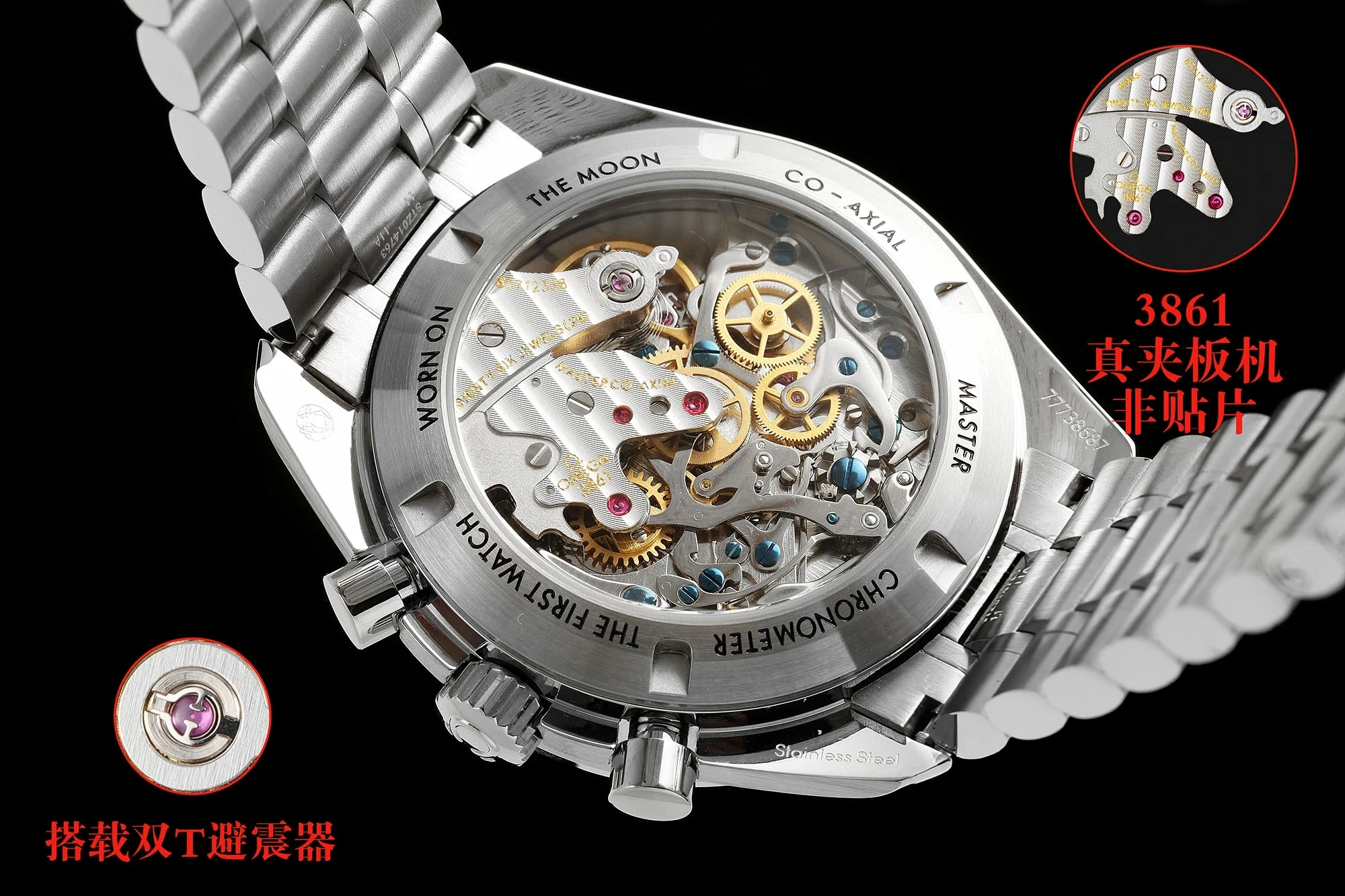
The fundamental issue: Omega’s Cal.3861 is a column-wheel manual-wind chronograph with an integrated chronograph mechanism. A true copy of it means engineering a complete chronograph caliber from scratch, and the Speedmaster sells in far smaller numbers than the Seamaster in the clone market, so most factories have not made one. Most Moonwatch clones use the ST19 (Seagull ST19) instead, a manual-wind column-wheel chronograph based on the Venus 175 architecture. The ST19 is a respected movement with decades of production history. It is also visibly different from the Cal.3861, and that difference creates the two tells that separate an ST19 Speedmaster clone from the genuine. Some newer factory photos, including those of our white-dial 310.30.42.50.04.001, carry a 3861 label; the caseback check further down shows how to see which movement a watch really has.
Omega Speedmaster Fake vs Real: The Two Tells
Tell #1: Subdial Spacing
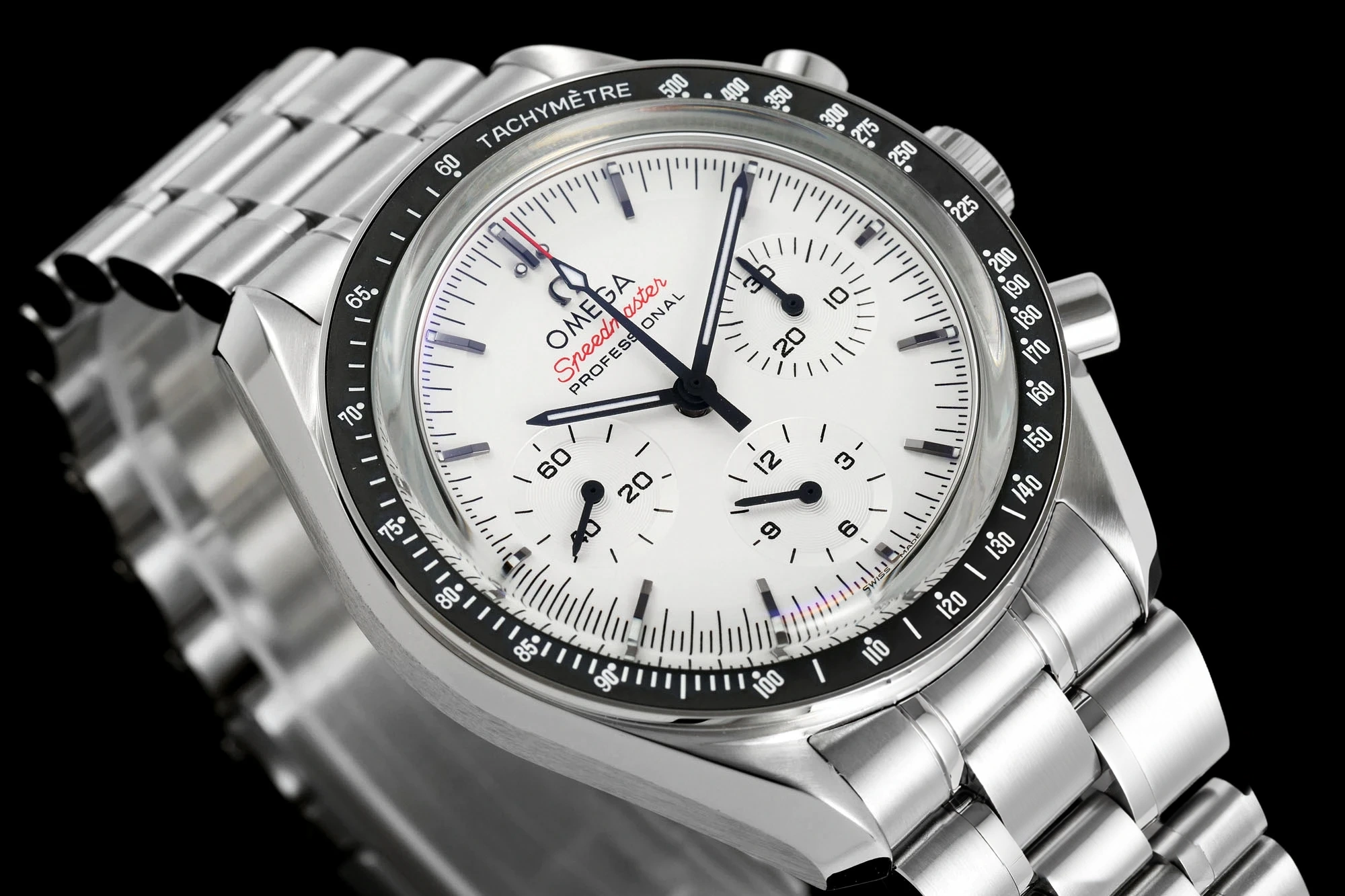
The genuine Cal.3861 positions its three subdials at specific locations: running seconds at 9 o’clock, 30-minute counter at 3 o’clock, and 12-hour counter at 6 o’clock. The distance between these subdials and their relationship to the dial center follow a geometry unique to the Cal.3861 architecture. The ST19 has a different internal layout, which forces the subdials into slightly different positions. On the replica, the subdials sit slightly closer to the center than on Omega’s watch.
Less than a millimeter. But it changes the visual balance of the dial — the negative space between subdials and hour markers shrinks, making the face feel marginally more crowded. People who have never held a genuine Speedmaster will not notice. People who own one — or who spend time studying comparison photos on forums — will spot it within seconds. The tell is most visible in the 30-minute counter at 3 o’clock, where the subdial edge encroaches on the “3” hour marker more than on the genuine.
Tell #2: Case Thickness
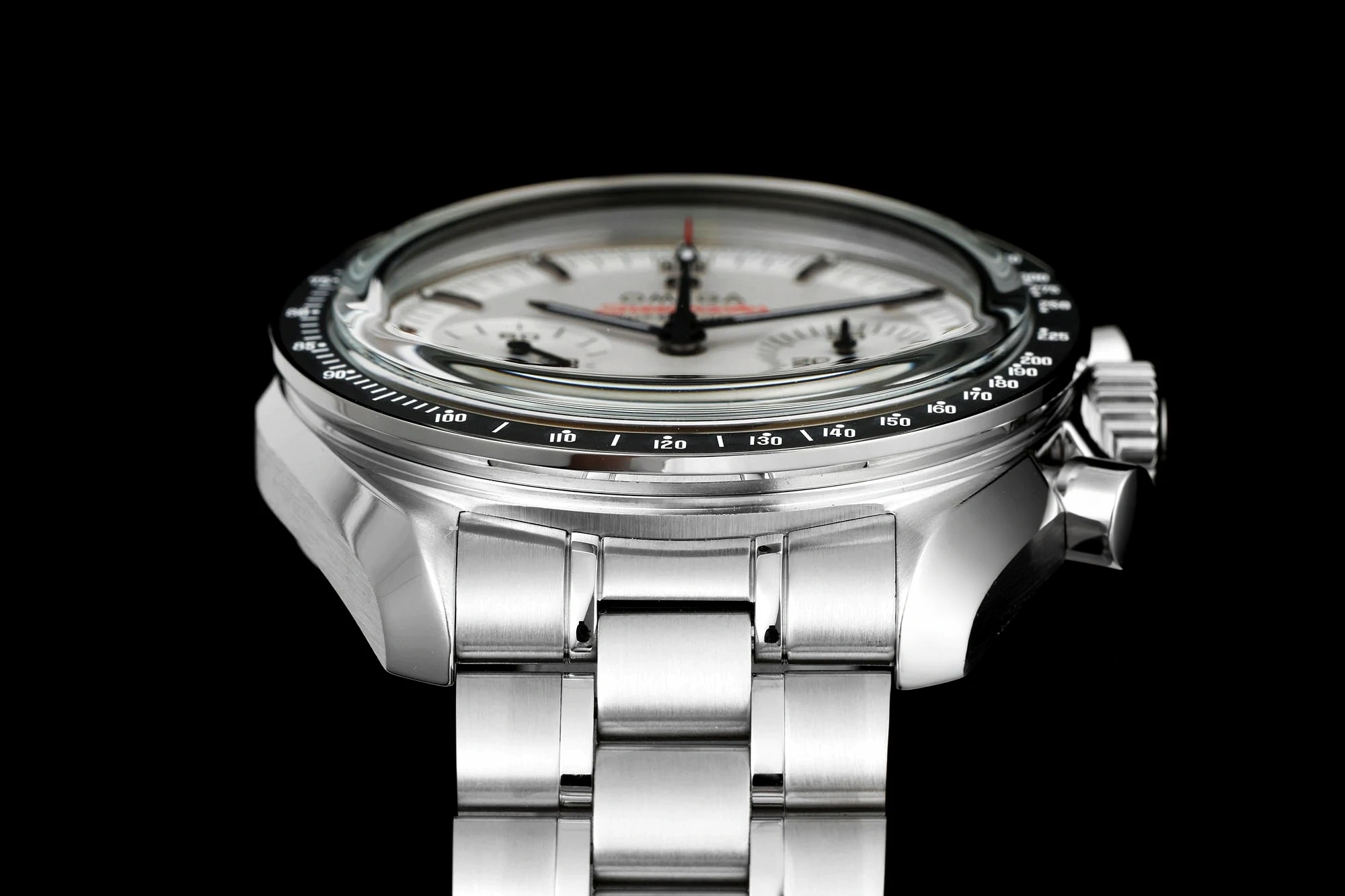
The genuine Speedmaster Professional measures 42mm x 13.18mm. Every ST19 version keeps the 42mm diameter but is thicker, because the ST19 sits taller than the Cal.3861. The caseback must accommodate this height difference, resulting in a noticeably thicker watch on the wrist. The practical impact: the genuine Moonwatch slides under most dress shirt cuffs with ease. The clone sits slightly proud, catching on tighter cuffs. With a casual shirt or bare wrist, the difference disappears.
Honest Take: These two tells — subdial spacing and thickness — are structural. No factory can fix them without building a new movement. They exist on every ST19 version, whichever factory made it. If you can accept them, the Moonwatch clone offers genuine chronograph function, correct exterior proportions (except thickness), and the emotional weight of wearing the Moonwatch silhouette. If you cannot accept them, the Seamaster collection offers Omega clones without these compromises.
How to Spot a Fake Omega Speedmaster: 5 More Checks
The two tells above need a real Moonwatch, or good photos of one, next to the watch you are checking. The five checks below work from a seller’s photos and video alone. The tests that apply to any Omega, such as the accent in TACHYMÈTRE, the serial number and the weight, are in our guide to spotting a fake Omega; here we stay with what is specific to the Moonwatch.
1. The caseback: which movement is inside
This is the check that settles most real vs fake questions. Omega’s Moonwatch Professional runs the hand-wound Cal.3861; an ST19 behind a glass back has a different layout of bridges and wheels, so ask for a clear photo or a short video of the movement. Some factories now sell a movement they call a 3861 type, and the factory photos of our white-dial 310.30.42.50.04.001 carry that label. A label is not proof, so compare the bridges in the video with photos of Omega’s caliber. Our guide to Omega clone movements sets the ST19 beside the other calibers.
2. The crystal
On Omega’s current Hesalite Moonwatch a small Omega symbol is etched into the centre of the crystal. It shows only when light catches it at an angle, and many clones leave it out. Ask for one photo taken at an angle under a lamp; the domed shape of the crystal should show in the same picture.
3. Dial print and hands
Put a photo of the clone beside one of the real watch at the same size. Compare the Omega logo, the Speedmaster script, the word Professional and the tachymeter numbers: letter thickness, spacing, and how far each line sits from the counters. A logo that looks bolder, or a script that sits closer to the counter at 3, is the kind of difference that shows here first. The hands should reach their tracks: the minute hand to the minute ring, the counter hands to the edge of their counters.
4. Bracelet and clasp
Look at where the end links meet the lugs: on a good piece they sit flush, with no gap and no play. Then look at the clasp, its engraving and how it closes. Close-up photos of both are easy to ask for, and they tell you more about the finishing than any front shot.
5. The chronograph in action
Ask for a video that starts, stops and resets the chronograph. The central seconds hand should start without a jump, stop where you stop it and snap back exactly to 12 on reset. The small seconds at 9 o’clock keeps running the whole time, because it shows the time of day, not the chronograph.
Every watch we ship goes through this kind of check with you first: you receive photos and a video of your own watch and approve them before it leaves.
The ST19 Movement: What You Get Instead of Cal.3861
The Seagull ST19 (also marketed as Venus 175) is a manual-wind column-wheel chronograph. Manual-wind means no rotor — you hand-wind the crown each morning. Column-wheel means the chronograph uses a traditional vertical coupling system that provides smooth start/stop/reset action. This is the same fundamental mechanism used in vintage Omega, Patek Philippe, and Valjoux chronographs. The ST19 is not a shortcut. It is a legitimate chronograph movement with a proven service record.
Performance specifications: 21,600 bph, 42-48 hour power reserve (genuine specifies 50 hours), and a daily rate that differs from one watch to the next. The chronograph function operates correctly: seconds hand starts, stops, and resets to zero. The 30-minute counter at 3 o’clock accumulates minutes accurately. The 12-hour counter at 6 o’clock tracks elapsed hours. All three functions work as they should on every properly QC’d unit.
Positive: The ST19 is the most repairable movement in the Omega clone market. It uses the same architecture as the Venus 175 — a movement that independent watchmakers have been servicing since the 1940s. Parts are widely available. Any watchmaker who services vintage chronographs can service an ST19. You will never be stranded with an unserviceable watch.
Hesalite vs Sapphire: Which Crystal to Choose
Omega produces the Moonwatch in two crystal variants. The Hesalite version (Ref. 310.30.42.50.01.001) uses acrylic crystal — the same material NASA qualified for spaceflight. It has a warm vintage character, domes slightly, and scratches easily but can be polished out with Polywatch paste. The Sapphire Sandwich version uses sapphire on both front and back, exposing the movement through a transparent caseback.
The omega moonwatch clone is available in both variants from most factories. The Hesalite version is recommended for two reasons. First: authenticity. The original Moonwatch that went to the moon used Hesalite (then called “plastic crystal”). The Hesalite version is the “correct” Moonwatch in the eyes of collectors and the NASA certification. Second: the Sapphire Sandwich version on the genuine shows the Cal.3861 through the caseback. The clone’s caseback shows the ST19 — which looks nothing like the Cal.3861. Choosing Hesalite avoids exposing the biggest visual tell on the watch. The solid caseback with the Hippocampus seahorse engraving hides the movement entirely.
Choose Hesalite if…
You want the authentic Moonwatch experience, prefer the warm vintage look, and want to hide the ST19 behind a solid caseback. Scratches polish out easily with Polywatch.
Choose Sapphire if…
You prioritize scratch resistance and do not mind the ST19 being visible through the caseback. Best suited if you rarely show the back of your watch to others.
Factory Comparison: SMF vs OMF vs JH
Unlike the Seamaster market (where VSF dominates), the Moonwatch market has three competitive factories, each with distinct strengths:
SMF (Superclone Master Factory) — currently the best overall Speedmaster clone producer. Their tachymeter bezel font is the closest to genuine, the case proportions keep the extra thickness to a minimum, and the bracelet has proper step-down architecture between links. The subdial spacing is still wrong (ST19 limitation), but SMF handles the dial printing and hand proportions with the highest accuracy available.
OMF (OM Factory) — makes a lower-priced alternative with good exterior quality but less refined dial printing. The “OMEGA” logo on the OMF version is marginally bolder than genuine. The bracelet clasp action is functional but lacks the crisp double-click of the SMF version. OMF suits buyers who want the Moonwatch silhouette for less than an SMF costs.
JH Factory — an older producer with established production lines but less frequent quality updates. JH Speedmasters from 2024+ are acceptable, but earlier batches had thicker bezel inserts and slightly misaligned chronograph hands. Check batch dates when ordering.
Why the Moonwatch Matters: A Quick History
In 1965, NASA put chronographs from Omega, Rolex and Longines-Wittnauer through eleven spaceflight qualification tests. They included heat up to 93°C, cold down to -18°C, 40G shocks, vibration, vacuum and humidity. Only the Omega Speedmaster survived all tests without failure. It earned the designation “Flight Qualified by NASA for All Manned Space Missions” — a certification that Omega has maintained continuously since then.
Buzz Aldrin wore a Speedmaster on the lunar surface during Apollo 11 in July 1969. During Apollo 13, the crew used their Speedmasters to time the critical 14-second engine burn that corrected their trajectory for Earth re-entry — the mission computer was down, and the watch was the only reliable timing instrument available. That 14-second burst — timed on a Speedmaster — brought three astronauts home alive. No other watch carries that kind of provenance. The replica lets you wear the shape of that story on your wrist. Omega still adds to the line: the 2026 reverse panda Moonwatch is covered in our new Omega 2026 roundup.
Perspective: The Moonwatch is the only watch in history to have saved human lives in space. Its replica has a different movement inside and carries the exterior design that earned that distinction: the asymmetric case, the tachymeter bezel, the stepped dial and the Hesalite crystal. Wearing one is wearing a tribute to that achievement. The ST19 inside is itself a proper chronograph movement — not a quartz shortcut, not a module on an automatic base. It winds by hand, it times events, and it counts to 12 hours. That matters.
Who Should Buy the Speedmaster Clone — And Who Should Not
Buy if you…
- Value the Moonwatch heritage and want to wear the silhouette
- Appreciate manual-wind ritual (daily hand-winding)
- Wear the watch casually (not under tight dress cuffs)
- Do not plan to compare side-by-side with genuine owners
- Want a proper mechanical chronograph, not just a three-hand watch
Skip if you…
- Want the most accurate Omega replica in our ranking
- Interact with Speedmaster owners who will spot the subdials
- Require thin profile for formal shirts and business wear
- Want the best possible Omega clone for the money
- Prefer automatic winding convenience over manual ritual
If you fall in the “skip” column, the Seamaster Diver 300M or Aqua Terra from VSF delivers a higher-accuracy clone with automatic winding and a thinner profile. The full Omega replica catalog shows every alternative.
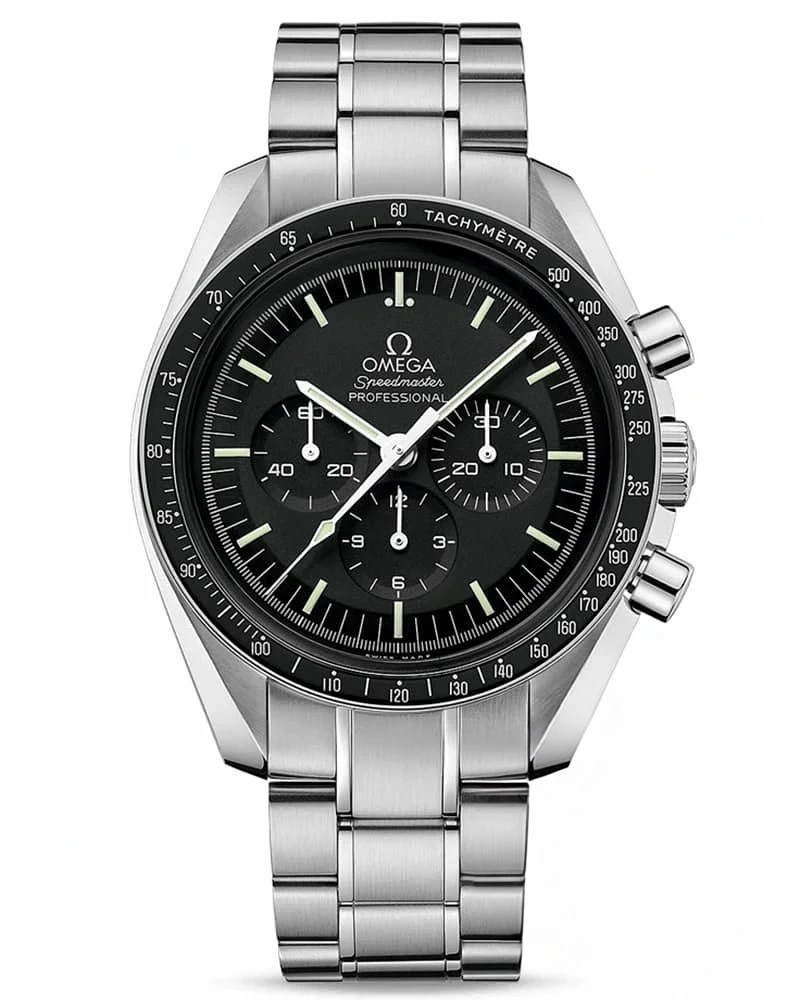
If the Moonwatch is the one for you, start with our Omega Speedmaster Moonwatch replica with the white dial, ref. 310.30.42.50.04.001. The Speedmaster Professional with the black dial, ref. 311.30.44.50.01.001, has the classic black face, and the panda-dial Speedmaster, ref. 311.32.40.30.02.001, is the smallest of the three at about 40mm. All three come on steel bracelets, and you see photos and a video of your own watch before it ships.
Frequently Asked Questions
Has any factory copied the Cal.3861?
Most Moonwatch clones still run the ST19, because building a full copy of an integrated chronograph caliber pays only at very high volumes, and the Moonwatch sells in far smaller numbers than the Seamaster. Some factories now advertise a 3861-type movement, and the factory photos of our white-dial 310.30.42.50.04.001 carry that label. Treat the label as a claim: ask for a video of the movement and compare its bridges with photos of Omega’s Cal.3861.
Is Omega’s own Speedmaster Replica a fake?
No. Omega itself used the word Replica for a Speedmaster: ref. 3594.50, launched in 1997, recreates the first Speedmaster of 1957 with broad arrow hands and a hand-wound movement. It is a genuine Omega, which is why searches for Omega Speedmaster replica vs original often land on it. A clone of the Moonwatch Professional is something else: a watch made outside Omega to look like Omega’s design.
Was a fake Speedmaster really sold for millions?
Yes, and Omega bought it. In 2021 a 1957 Speedmaster ref. 2915-1 sold at Phillips in Geneva for CHF 3,115,500, a record for the model. In 2023 Omega said the watch had been assembled from parts that did not belong together and that former employees were involved. That was a vintage piece built from mixed parts, which collectors call a Frankenwatch, not a modern clone. For a modern Moonwatch, the seven checks above are the ones that matter.
Is the MoonSwatch a better alternative?
Different product, different purpose. The MoonSwatch (Swatch x Omega) is an official product with correct Speedmaster proportions — including case thickness — because it uses a thin quartz movement. The tradeoff: BioCeramic plastic case, quartz chronograph (not mechanical), and no sapphire or stainless steel. The ST19 version uses a real mechanical chronograph movement and a steel case but has the wrong thickness. MoonSwatch nails the proportions; the clone nails the material and movement type. Neither nails both. Read the full MoonSwatch vs Speedmaster replica comparison for a detailed breakdown.
How do I wind the ST19 movement correctly?
Unscrew the crown (counterclockwise until it pops out one click) and wind clockwise. You will feel steady resistance, then a hard stop when the mainspring is fully wound; do not force past that point. The mainspring has no slipping bridle like modern automatics, so over-winding can damage the barrel. After a few days in a drawer, 20-30 turns get the watch going before you set the time. Winding it each morning before you put it on soon becomes a habit.
Can I use the chronograph daily without wearing out the movement?
Yes — the ST19 chronograph was designed for regular use, not occasional timing. Running the chronograph seconds hand uses a little more power, so the watch runs down a bit sooner, but it does not accelerate wear beyond normal service intervals. The column-wheel mechanism and horizontal coupling clutch are built for repeated engagement. Use the chronograph freely — that is the entire point of owning one.
What strap options work with the Speedmaster clone?
The Speedmaster uses 20mm lug width. The steel bracelet (included) is the classic look. A black leather rally strap with perforations gives a vintage racing aesthetic that many enthusiasts prefer. Omega-style NATO straps (the same Bond-style strap worn by astronauts) fit correctly and reduce wrist presence. Velcro straps — the actual type astronauts used over their spacesuits — are available from aftermarket sources and fit the Speedmaster aesthetic perfectly. Check the Speedmaster collection for all available references.
The Final Calculation
Fake vs real, a Speedmaster clone is a compromise you can measure. You get a genuine manual-wind chronograph movement with a proven service record, housed in a Moonwatch-style case that differs from the original in two measurable ways: subdial spacing and thickness. The ST19 winds by hand, times events accurately, and runs for over 40 hours between winds. The Hesalite crystal delivers the correct vintage warmth. The tachymeter bezel reads “TACHYMÈTRE” in the correct font. The watch looks right, feels right, and functions right — it just cannot fool someone who measures to the millimeter. For most wrists and most moments, that is enough. The Moonwatch is about legacy, not perfection. Its clone carries that legacy forward with a mechanical heart that beats 21,600 times per hour — just like the watches that went to the moon.